From a tandem in Portugal, to 100 jumps at Black Knights

The Calm you Don’t Expect
Before my first AFF jump, I expected pure chaos. The moment I jumped was going to be overwhelming, panicked and full of confusion.
I imagined falling out of control, having no memory of what I was taught, and landing so far from where I was meant to.
So far away that even the Chief Instructor would be impressed.
Skydiving was meant to feel crazy and uncontrolled, the sort of activity where adrenaline takes over and you can’t do anything except hope. How wrong was I!
Freefall starts and something unexpected happens. Everything goes… calm.
It isn’t quiet. The wind is loud, and there’s an awareness that you are plummeting towards earth.
But there is a calm in a way that you just can’t explain to someone who hasn’t experienced it.
You think about almost nothing, and you exist in that 15,000ft gap between the plane and the ground.
That gap gave me the most peace I’ve ever felt.
A Promise to the Sky
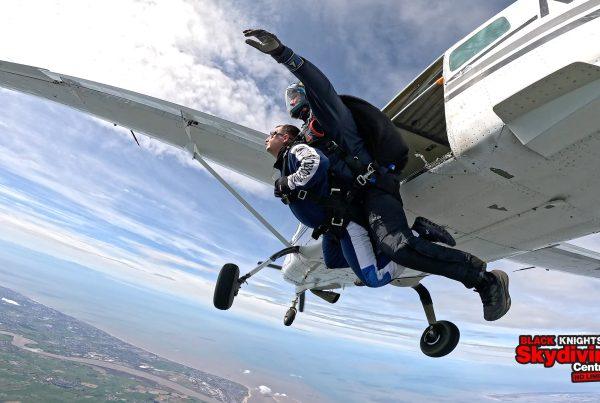
My first skydive was an impulsive decision to do a tandem whilst holidaying in Portugal, in May 2024.
I signed up to a ‘once in a lifetime’ experience, a tick box exercise to mark skydiving off a list, before going back to ‘normal life’. So, off I went, to fall towards a field on the coast of the Algarve.
I fell (or should I say, I was pushed), I flew, I landed. And then I heard…
“This time next year, I’ll have my license”…
What was I even thinking!
It wasn’t a plan, it wasn’t even a realistic idea. But it stuck.
The memory lingered, way longer than the adrenaline ever could, and slowly, something I hadn’t initially wanted to do, became something else.
Skydiving became something that I needed to do again.
I started my AFF course with Black Knights in March 2025. And then, less than 12 months after my tandem, I had my license.
Somewhere between the two, skydiving stopped being something I once tried and became something that I’m a part of.
A Lesson in Trust
AFF could be described as a course that teaches you how to skydive, and in many ways it does.
You learn how to jump from a plane, how to be stable in freefall, and how to fly and land a parachute safely.
You’re introduced to things like wind layers, cloud cover, airspace restrictions, and you get a glimpse of just how technical this sport actually is.
Beneath all that is a much greater, and much quieter lesson, that takes longer to learn.
Trust.
Trust in your instructors, guiding you through the early jumps with a mixture of professionalism and humour.
Trust in the equipment to do exactly what it’s designed to do.
And, eventually, trust in yourself, which for me was the hardest lesson to accept, and a lesson I still learn every time I jump.
The lesson in trust started during my Level 4 jump. I completely lost control and in a moment of panic, spinning like the blades of a helicopter, I reached out, prayed, and grabbed the instructor’s hand like a child running to his mummy.
It wasn’t a proud moment, but it was an important one. It forced me to listen more carefully, slow down, and realise that learning in skydiving isn’t about getting everything right the first time.
It’s about making mistakes, understanding them, and improving one step (or hand grab) at a time, whilst being able to trust yourself to put all of the things you learn into practice.
The People Behind the Sport
From day one at Black Knights, I could feel a balance in how things were done.
Instructors were joking, laughing, creating an environment that felt relaxed. But there was always a strong sense of safety and professionalism.
It didn’t take long to see that that’s what every good dropzone needs.
What really stood out was how quickly people made the effort to include me.
From conversations in the packing area, advice offered without being asked, and invitations to the pub at the end of the day, it all made a huge difference. It only took a small handful of people to create a sense of belonging.
I think there’s something distinctly northern about Black Knights (and possibly at every drop zone).
Everyone looks out for each other. They celebrate each other’s successes, laugh and learn with you at mistakes, and share knowledge in a way that helps everyone improve.
It’s a collective experience for everyone.
It’s togetherness.

The Moments That Stay with You
With only one year in the sport, there are certain ‘early’ moments that stand out.
One of those moments was my first ‘high pull’. Opening just under 10,000ft, spending time flying around with no urgency to land. Looking back, it was the first time I fully appreciated how peaceful the sky is when you allow yourself to slow down and take it in.
Another moment, for a different reason, was a formation jump over Cornwall for a friend’s 200th jump. Watching him deploy while the rest of us tracked away across the view was one of those moments where everything just came together, the flying, the environment, and the people around you.
It wasn’t just about the jump, it was about being part of something shared, with people you want to share it with.
These are the type of moments that stay with you, and often more than the jumps that go exactly to plan.
100 Jumps In
Reaching 100 jumps in my first season felt like a milestone, but not in the way you might expect.
It wasn’t a milestone where suddenly everything felt mastered, but rather a point of understanding for how much more there is to learn.
The contrast between the early jumps and now is really noticeable.
At the start, the focus was simply about getting through the jump. Now, now there’s an awareness of what surrounds the jump.
Things like wind conditions at different altitudes, canopy controls, pre-jump planning, and how each part of my skydive connects not only to my jump, but to everyone else’s on the plane with me.
There’s definitely more confidence. Not just in my ability to perform certain skills, but in the willingness to try, to ask questions, and to learn from others.
Things that felt intimidating, like spinning out of control, feel like part of the process.
Things that felt a million miles away, like jumping with friends, become part of your routine.
In the grand scheme of skydiving, having 100 jumps doesn’t mean you’ve mastered anything.
If anything, having 100 jumps is like having 1 jump all over again.
I’m still new, I’m still learning, I’m still hungry for progression. The difference is, I now know how to approach learning and progression safely.
Looking Ahead
With only around 130 jumps, I’m at the beginning of my journey.
I’m starting to explore new disciplines like free flying and canopy formation.
I’ve got new drop zones to visit.
There’s a lot more to learn, and that is part of what makes the sport so engaging.
But if there is one thing that my first year in skydiving taught me, it’s that fear never truly disappears, you just learn to move with it.
And, on the other side of that fear, you find something you didn’t expect. Freedom. Belonging. Presence. And most surprisingly… calm.